
What Is Expressive Arts Therapy?
Expressive arts therapy is an approach that uses creative expression, making art, music, movement, or writing, to process emotion and support psychological healing. It rests on a simple observation: a color, a sound, or a gesture can carry feeling that a person cannot yet explain, and engaging that creative response can open up material that stays locked when the only tool is conversation.
It is especially useful for people who find traditional talk therapy difficult, whether because emotions are hard to verbalize, because trauma feels unsafe to speak about directly, or because words alone keep skating over the surface. The point is worth stating plainly, since it stops some people before they start: you do not need to be artistic, and there is no good or bad outcome. The healing is in the making and the expressing, not in the finished piece.

How Creativity Supports Recovery
The value here is not just emotional release in the moment, though that happens. Making something gives experience a form you can look at, work with, and rethink, which is what allows new meaning to emerge from it.
For someone in recovery, that does a few specific things. It offers a way to process painful experiences without having to narrate them directly, which can lower the wall that talk therapy sometimes runs into. It builds emotional regulation through the structure of a creative activity, giving a contained place to feel something intense. And it opens up a question that matters enormously in recovery but rarely gets asked head-on: who are you apart from the addiction? Creating lets people explore an identity beyond the diagnosis, which is part of what makes recovery something to move toward rather than just something to maintain. The research base for expressive arts therapy for addiction in San Diego, CA is still developing, but it increasingly supports what clinicians have long observed, that creative work strengthens engagement and emotional processing alongside other treatment.
Could Expressive Arts Therapy Help You?
It tends to resonate with people in a few recognizable situations, and you do not have to fit all of them for it to be worth trying.
You might find it useful if putting emotions into words has always been hard, or if you feel numb, disconnected, or flooded in a way that talking has not touched. It often reaches people carrying trauma that feels unsafe to verbalize directly, and people who have bounced off traditional therapy and assumed therapy itself was the problem. If you are drawn to creativity, or used to be before addiction crowded it out, that is a natural fit too. And if substances have been the main way you escape painful feeling, a different outlet for that feeling is exactly what this offers.
The Forms It Can Take
Expressive arts therapy is not one activity but several, and a good program draws on whichever fits the person and the moment.
Art therapy uses visual work, drawing, painting, sculpture, collage as a mirror for what is going on inside. Music therapy might mean listening, writing lyrics, playing, or group drumming, all of which can shift mood and surface emotion. Dance and movement therapy uses guided movement to reconnect with a body that trauma often teaches people to leave, since some experiences are stored physically rather than verbally. Drama therapy uses role-play, improvisation, and storytelling to rehearse expressing and handling difficult emotions. And writing therapy, through journaling, poetry, or narrative work, helps organize thoughts and, importantly, rewrite the story a person tells about themselves. Different forms reach different people, which is why having a range matters.
What to Expect in a Session
Our expressive arts therapy for addiction in San Diego, CA happen in a safe, nonjudgmental setting, individually or in a group, depending on your plan, and they are guided by a therapist rather than left open-ended. You do not need to arrive with anything or know what you are doing.
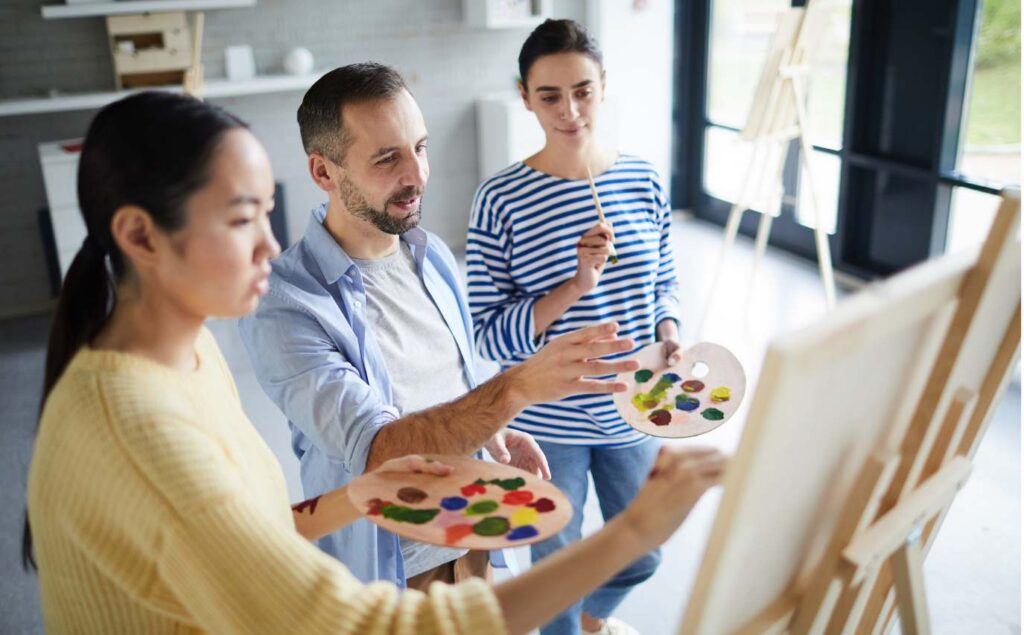
A session might involve creating something visual, musical, or movement-based, then reflecting on whatever surfaced through it, often symbolically rather than through direct explanation. Group sessions add a layer of connection, since making something alongside other people in recovery builds the kind of bond that eases shame and isolation. Emotions can come up, and that is welcome rather than a problem; your therapist is there to help you process whatever arises safely. The aim is never to produce good art. It is to access feeling, work with it safely, and support the recovery underneath.
The Benefits of Expressive Arts Therapy in Recovery
The value of creative work in recovery goes beyond release in the moment, though that happens too. Making something gives experience a form you can look at, work with, and rethink, and that opens up several things that matter in getting and staying sober:
- A way to process pain without narrating it. Creating lets you work through difficult experiences symbolically, which can help you move past the wall that talk therapy sometimes hits when something feels impossible to say out loud.
- Stronger emotional regulation. The structure of a creative activity gives intense feelings a contained, manageable place to go, which builds the capacity to sit with emotion rather than escape it.
- Less shame and isolation. Making something alongside other people in recovery builds genuine connection, and that shared experience eases the shame and aloneness that so often feed use.
- An identity beyond addiction. Creative work opens up the question recovery rarely asks head-on: who are you apart from the substance? Exploring that is part of what makes recovery something to move toward, not just maintain.
- Better engagement with treatment overall. People often find creative therapy is the part they actually look forward to, and that pull into the process tends to strengthen the rest of the work.
The research base for arts therapies in addiction is still developing. However, the data increasingly supports what clinicians have long observed in the room: creative work strengthens emotional processing and engagement alongside other treatments.


 (833) 530-0291