
You’ve spent your career running toward emergencies while everyone else runs the other way. Admitting the job has caught up with you feels impossible, and stigma keeps many first responders silent. A diagnosis on record can put a badge, clearance, or license at risk, so many delay rehab for first responders in California for years. At Assure Recovery Center, we treat co-occurring addiction and post-traumatic stress together, with confidentiality built into every stage of care. You don’t have to carry this alone or figure out the first step on your own.
Why First Responders Avoid Getting Help
In first-responder culture, asking for help can be seen as a weakness in a job built to reward toughness. A visit to a therapist becomes a rumor on shift. A referral to counseling becomes a mark next to your name at the next promotion cycle. None of it appears in any written policy. Everyone on the job still knows the rule: stay quiet and carry it alone.
For a badge holder, the concern isn’t abstract. A documented mental health diagnosis or substance use disorder can raise fitness-for-duty questions. Those questions can threaten your clearance, assignment, or standing with your department. Corrections officers carry an added worry: anything on record could affect custody clearance. Dispatchers, who never leave the console, often feel left out of this conversation. Their trauma is absorbed secondhand through the calls they take, yet it can feel like it doesn’t count.
None of this is paranoia. It’s a rational response to a profession that rewards toughness and treats vulnerability as a liability. The culture of powering through gets you through a shift. It isn’t built to recognize when years of occupational trauma catch up with you.

Why First Responders Face Elevated Risk for Trauma and Substance Use
Every shift adds another incident to a running total that most people never have to keep. A single call, a fire, a crash, an overdose, might be someone else’s worst day. For you, it’s one of thousands over a career. Repeated exposure to critical incidents changes how the brain and body respond to stress over time. Exposure like this adds up, and it helps explain elevated behavioral health rates in this profession. Those rates run higher here than among the general public.
SAMHSA’s first-responder category includes police, fire, EMS, and dispatch and telecommunications personnel. These workers develop behavioral health conditions such as depression and PTSD at a rate approaching 30 percent. Among the general public, the rate is roughly 20 percent. NIMH estimates PTSD affects roughly 6.8 percent of U.S. adults at some point in their lives. About 3.6 percent are affected in a given year. Repeated critical incident exposure is a major reason the risk climbs above baseline for people in this work.
Every Role Carries Its Own Exposure
Not every first responder faces the same exposure or works the same schedule. Patrol work, fire response, emergency medicine, dispatch, and custody work each carry a distinct pattern of stress. Each deserves its own name.
- Police officers, who carry the unpredictability of patrol and the weight of split-second decisions
- Firefighters, who respond to fire, medical, and rescue calls with cumulative physical and psychological wear
- Paramedics and EMTs, who absorb the acute trauma of medical emergencies, call after call
- 911 dispatchers and telecommunicators, who experience trauma secondhand through the calls they take without ever leaving the console
- Correctional officers, who work inside a high-stress custodial environment with its own risks for trauma exposure and substance use, including alcohol use disorder
Every role carries its own version of the same reality. All of them absorb what most people spend a lifetime avoiding. The exposure looks different from one role to the next, but the toll it takes often looks similar. Then they do it again the next day.
How Trauma and Substance Use Overlap
Trauma and substance use tend to overlap with one another. What starts off as an occasional drink after work can develop into a regular habit. Initially, you notice stress and anxiety decrease. Yet, over time, you need to drink more to achieve the desired effects. The same is true with other substances. PTSD symptoms managed this way often get worse the longer they go untreated.
Addressing a co-occurring disorder requires a coordinated approach. Both conditions need treatment at the same time. Ignoring one in favor of the other can lead to setbacks or relapse. By addressing both conditions in a personalized care plan, you can start to overcome substance use while effectively addressing any unresolved trauma.
How Assure Recovery Center Treats First Responders
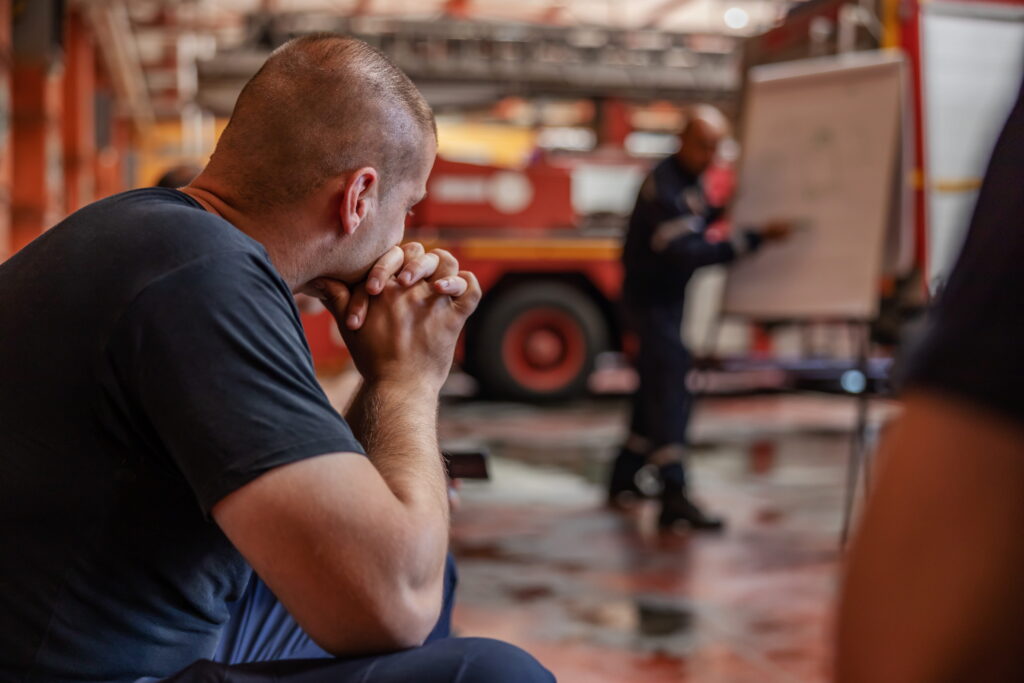
At Assure Recovery Center, addiction and PTSD are treated as one connected picture. Rehab for first responders in California works this way through evidence-based therapies addressing trauma directly. NIMH names cognitive processing therapy, prolonged exposure therapy, and EMDR (eye movement desensitization and reprocessing) as first-line treatments for PTSD. Our clinical team draws on these same modalities inside a trauma-informed program built around your history and exposure.
How We Keep Your Treatment Confidential
Concerns about your career do not go away once you start treatment. We designed this program with those concerns in mind. Everything about your visit stays confidential, including your admissions paperwork and daily communication with our team. Some cases require additional discretion, particularly when a department, clearance, or ongoing legal matter is involved. Speak with our admissions team about your specific concerns, and we will build your plan around them from day one.
Peer Support From People Who Understand the Job
Our staff includes individuals with lived experience in first-responder culture. Many of them have taken a 3 a.m. call themselves. Others have sat with a dispatcher’s console still ringing in their ears hours later. You will not have to explain your job before you explain what it has done to you.
DHCS-Certified Care in San Diego
We are DHCS-certified and nationally accredited. We offer first responders rehab in San Diego, close enough to begin care without uprooting your life or your family. What works best for you depends on where you are starting. Options include medically supported detox, residential treatment, a partial hospitalization program (PHP), or an intensive outpatient program (IOP). Your plan can move to a different level of care as your needs change. There is no fixed end date decided in advance.
Family matters too. Addiction and PTSD affect the people closest to you almost as much as they affect you. We build family support into care. You won’t be managing recovery alone at home.

Begin Rehab for First Responders in California Today
Reaching out for rehab for first responders in California starts with one confidential conversation. It’s true whether you’re a first responder or a family member reaching out on someone’s behalf. You don’t have to have everything figured out before you contact us. We’ll listen, answer your questions, and help you understand what a realistic next step looks like. Care built around you starts with a conversation, not a commitment.



 (833) 530-0291